Water Heater, Drain & Sewer — Open 24/7
Plumber in Santa Clarita, CA
Water heaters killed by hard water, slab leaks under 1970s and ’80s tracts, drains that clog on a schedule — in Valencia, Saugus, Canyon Country and Newhall, handled by licensed plumbers with free estimates and upfront pricing.
- 24/7 emergency service
- Free estimates
- Same-day availability
- Priced before work starts
- Financing available
- Se habla español
They worked on December 31, even though it was a holiday as well as New Years, and they did an excellent job. They made sure that all the work was done professionally thank you Eric. You will always be highly recommend.
I want to thank Eric and the team at RPM They came on time, gave a reasonable price and did the job all while keeping my house and work area clean. The quality of customer service is second to none 10 out of 10 would recommend!
Request a free estimate in Santa Clarita
No charge for the estimate, and we price the job before any work starts. Prefer to talk? Call (888) 855-6680 — someone answers 24/7.
- Serving
- Santa Clarita, Stevenson Ranch and the Santa Clarita Valley
- Hours
- Open 24 hours a day, 7 days a week
- Dispatched from
- 1601 Paramount Blvd., Montebello, CA 90640
- License
- Licensed, bonded and insured — CSLB #1004038
- Estimates
- Free, with the price agreed before any work starts
- Languages
- English and Spanish
- Financing
- Available through Hearth for larger repairs and replacements
- Emergencies
- Nights, weekends and holidays on the same number
Local, Licensed & Available 24/7
About Our Santa Clarita Plumbers
Rooter & Plumbing Masters holds California contractor license CSLB #1004038 and takes plumbing, drain and sewer calls throughout Santa Clarita: in Valencia, Saugus, Newhall and Canyon Country inside the city, and in Stevenson Ranch, which lies outside the city limits. Our Santa Clarita plumbers answer the phone around the clock. An estimate costs nothing, and the price is settled with you before a wrench is picked up.
Santa Clarita is a young city wrapped around two old towns. The city’s Housing Element dates Newhall to 1876 and Saugus to 1887. In that same year of 1876, by the city’s account, California Star Oil Works built a refinery in Newhall to turn crude oil from Pico Canyon into kerosene for lamps. The city opened the site to the public in June 2025 as Pioneer Oil Refinery Park and describes it as the oldest surviving oil refinery in California. Just to the west of it is Hart Park, once the ranch of a silent film star, and the city says some of the earliest silent movies were filmed on Newhall’s Western streets and in the canyons of Santa Clarita. Cityhood came much later. Residents formed a committee in 1985 to bring the old towns under a local government of their own, and in 1987 Santa Clarita incorporated with 39.5 square miles. Forty neighboring communities have been annexed since. By the city’s count it had 230,428 residents at the start of 2025, the third largest population in Los Angeles County.
That late start shapes the plumbing. According to the Housing Element, Santa Clarita saw very little construction before the 1960s, more than 60 percent of its homes went up between 1980 and 2009, and fewer than a third were built before 1980. Roughly 73 percent are single-family houses. The pipes under the streets are the same age: the city’s 2025 sewer management plan lists about half of its sewer mains as laid between 1960 and 1979, about a third between 1980 and 1999, and none before 1960. So the 1920s pipe that older cities struggle with is rare here. The older housing is in parts of Newhall, Saugus and Canyon Country, which the city surveys for housing condition because of their age. A house from the 1960s typically has cast iron and clay drain pipe that is failing by now, and a newer house has hard water to contend with.
Plumbing Problems We See Most in Santa Clarita
Hard water and water heaters. SCV Water, the valley’s water agency, reported an average hardness of 354 milligrams per liter in its groundwater for 2025, within a range of 220 to 480, and 160 in its imported surface water. The agency’s explanation is that groundwater picks up calcium and magnesium on its way down to the aquifer. In a tank water heater that mineral settles to the bottom as sediment. Once the tank itself leaks, the answer is a new water heater, every time. Our water heater repair in Santa Clarita covers tank and tankless units, and for a residence the city issues the water heater changeout permit online.
Kitchen drains that clog again and again. A cable only pokes a hole through grease, and the hole closes. For a line that keeps coming back, hydro jetting in Santa Clarita is our usual fix, because it washes the wall of the pipe clean. The county’s sewer maintenance district, which looks after the city’s sewers, asks residents to keep fats, oils and grease out of the drain, since they harden and stick to the inside of the pipe. Restaurants and other food businesses are a regular part of our commercial plumbing work.
Roots where the lateral meets the main. County crews inspect the city’s sewer mains by camera. When they see roots coming out of a private lateral, the owner gets a letter asking for the line to be serviced by a licensed plumber within 90 days. Our drain cleaning clears the lateral, and every main line clearing is followed by a complimentary camera inspection, so you learn whether the pipe was only blocked or is cracked as well. What that letter means, and who owns which pipe, is explained under sewer laterals in Santa Clarita further down.
Pipe that is broken, not blocked. A crack, a sag or a joint that has pulled apart will not clean out. That length needs a drain repair, and a line that has failed along its whole run is a drain replacement.
Leaks under a slab or inside a wall. A warm patch of floor, the sound of water running with every tap closed, or a water bill that has jumped all point to a pipe leaking out of sight. Our leak detection finds the spot with listening equipment, and with tracer gas where that is needed. Under a slab we can repair the one spot or reroute the line, and the reroute is what we usually recommend. If a floor does have to be opened, we close it with a rough concrete patch and the finished flooring is left to you.
Water pressure that runs too high. SCV Water’s service rules say it tries to keep its system between 40 and 150 pounds per square inch, and that where the static pressure is above 80 a pressure regulating valve is required on the customer’s line. That valve is the property owner’s to maintain. When one wears out the pressure can climb, drop or swing, and replacing it is routine plumbing repair.
Gas lines. The city’s Housing Element names Southern California Gas Company as the supplier of natural gas in Santa Clarita. The piping past the meter is the owner’s, and it is what has to change when a house gets a gas range, a dryer in a new spot, a tankless water heater or a backyard fire pit. We run a gas line in Santa Clarita sized for the new load, do the trenching for an outdoor line, and pressure test the work before it goes into service. We also install motion-type earthquake shutoff valves.
Get Our Services
Talk to a Santa Clarita Plumber
Describe what is happening and we will tell you what kind of call it is. Sewage rising in a shower or a floor drain means the main line is blocked, and that is emergency plumbing whether it is noon or the middle of the night. A water heater that has stopped heating, a faucet that drips or a toilet that will not stop running can usually wait for a scheduled visit. Buying a house in Valencia or Saugus? A sewer camera inspection before you close shows you the lateral you are about to own. Our Santa Clarita plumbers are at (888) 855-6680, and a person picks up. Se habla español.
Experienced Professionals
Plumbing Services for Santa Clarita Homes and Businesses
Santa Clarita has grown from 39.5 square miles to more than 70, and we take calls from all of it: Newhall at the south end, Valencia around City Hall, Saugus to the north, Canyon Country on the east side, and Stevenson Ranch over the city line. Each truck carries a hydro jetter, a sewer camera and electronic leak detection equipment for finding hidden leaks. When a sewer line runs under a driveway, a pool deck or a slab, ask about trenchless repair. We do three kinds: cured-in-place pipe lining, pipe bursting, and an epoxy spray coating inside cast iron pipe. Which one fits depends on what the camera shows. A house whose water lines have leaked more than once may be a candidate for repiping, and Santa Clarita issues a repipe permit for a residence online. We install and repair sinks and showers and bathtubs, and our scheduled plumbing maintenance covers the water heater, the drains and the fixtures. You get a free estimate and a price you have agreed to before the job starts.
Our Plumbing Services in Santa Clarita, CA:
Santa Clarita Sewer Lines
Who Is Responsible for a Sewer Lateral in Santa Clarita?
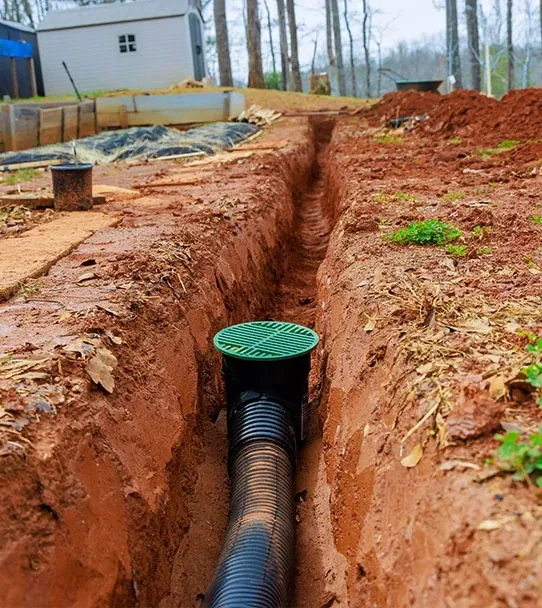
The owner of the property it serves, for its full length, and that includes the part under the street. Three agencies share the public side. The City of Santa Clarita owns the sewer mains. Los Angeles County Public Works maintains them for the city through its Consolidated Sewer Maintenance District, an arrangement that goes back to February 14, 1989, and the city’s sewer management plan notes that the city kept ownership. The Santa Clarita Valley Sanitation District owns the large trunk lines and treats the wastewater at two plants, one named for Saugus and one for Valencia.
The lateral sits on the private side of that line. Santa Clarita’s municipal code adopts the county’s sewer ordinance, and the ordinance requires house laterals to be kept in a safe and sanitary condition by the owner of the property served. The county district says it more plainly to homeowners: laterals are entirely owned by the private property owner they serve, and the owner is responsible for the entire length, including the portion in the public right-of-way, under the asphalt and the street landscaping.
The public system is large and fairly young. The 2025 plan counts about 500 miles of gravity sewer serving some 230,000 residents, predominantly vitrified clay pipe and most of it eight inches in diameter. The Valencia treatment plant went into operation in 1967, and the sanitation district gives its design capacity today as 21.6 million gallons a day.
When the County Finds Roots in Your Lateral
The maintenance district inspects the mains by camera, and its reports to the city include the defects it sees in private laterals. Its standard notice tells the owner that a camera found roots at the lateral connection and asks that a licensed plumber service the line within 90 days. Two of its instructions are aimed at the plumber. Roots and debris cut out of the lateral have to be caught in a basket at the manhole downstream, so they do not end up in the main, and the district’s local maintenance yard has to be notified before the cleaning to authorize access to that manhole. The district also suggests a regular cleaning schedule for a lateral that has had roots, because they are likely to come back.
Who May Work on Which Part of a Lateral
- On your property. The line between the building and the property line is permitted by the city’s Building & Safety Division, and the city’s sewer connection sheet says the owner or a licensed contractor may do that work.
- In the public right-of-way. From the property line to the main, the same sheet requires a city encroachment permit and says the lateral must be built by a licensed contractor with a C-42 license. The city’s plumbing code adds that no one may install, remove, alter or repair any part of a sewer in a public way without the approval of every agency that has a say over that street or utility.
- At the main. Where the main has no fitting for a new connection, the county’s crews install the saddle themselves. The contractor digs the trench and supplies the part, and the county taps the pipe.
- Freshly paved streets. Santa Clarita does not allow a cut in a street for five years after it is built, rebuilt or overlaid, or for two years after a slurry seal. Emergencies are the exception, at the city engineer’s discretion.
- Working hours. On residential streets the city’s encroachment rules set the working day at 7:00 a.m. to 4:00 p.m.
We clear laterals all the way to the city main, and our repairs run that far too. For the section in the public right-of-way, Santa Clarita’s sheet calls for a contractor with a C-42 license working under a city encroachment permit. When a repair reaches the right-of-way, that section is done under the city’s encroachment permit. Along the whole line, a trenchless repair is our default and an open trench is the exception, kept for a pipe that cannot be repaired any other way.
If a Sewer Backs Up in Santa Clarita
- Stop running water. Everything in the building drains to one pipe, so a flush or a load of laundry comes out at the lowest drain.
- Work out whose pipe it is. A spill or an odor coming from a public sewer goes to the county’s sewer hotline, (800) 675-4357, which the city lists as answered 24 hours a day, seven days a week. A backup that stays inside the house or the yard is in the lateral, and the lateral is yours.
- Look for a cleanout. We open a blocked main line through the outside cleanout. If the house has no cleanout, the blockage is reached from a toilet or from the vent on the roof, and a cleanout can be installed after the line is clear. The county recommends a cleanout and a backflow preventer on every lateral.
- Finding the lateral. The city’s Engineering Services Division, at (661) 255-4942, will search its record drawings and give the approximate location of a private lateral.
- Buying a house here? Have the lateral inspected before the sale closes, because all of it becomes yours. Our buyer’s sewer camera inspection includes the video and a written summary.
Santa Clarita Water
Where Does Santa Clarita’s Water Come From?
From SCV Water, formally the Santa Clarita Valley Water Agency. An act of the state legislature created it on January 1, 2018, by merging the valley’s water agencies, and the city’s Housing Element names it as the water provider for Santa Clarita. Its oldest piece began in 1913 as a small water system in Newhall. In its 2026 water quality report, which covers 2025, the agency says 66 percent of its supply was imported water that travels hundreds of miles to get here, 33 percent was local groundwater, and about 1 percent was recycled water for outdoor irrigation. It counts more than 75,500 service connections and 967 miles of pipeline.
The agency’s customer service policy draws the line at the meter. SCV Water owns, operates and maintains the service connection, and the meter and its box are agency property. From the outlet of the shutoff valve on the downstream side of the meter, the pipe is the customer’s service line, and the property owner is responsible for it. For a break or a leak on the agency’s side, or an outage, the number is 661-294-0828, and SCV Water says its technicians respond 24 hours a day.
How Hard Is Santa Clarita’s Water?
Hard, and harder in some years than in others. The 2026 report lists hardness of 354 milligrams per liter on average in the agency’s groundwater, within a range of 220 to 480, and 160 on average in its surface water, which is the imported supply. SCV Water tells customers that the hardness comes from calcium and magnesium the groundwater picks up as it soaks down to the aquifer, and that the water can seem harder during a drought, when less imported water is available and more has to be pumped from the ground. The minerals are no threat to health, the agency says. They are what leaves spots on glass and scale inside a water heater. On lead, the report says the service line inventory the agency carried out in 2024 found none in its system.
Salt-Based Water Softeners Are Not Allowed Here
This is the rule that surprises people who move to the valley. Santa Clarita’s plumbing code prohibits automatic or self-regenerating water softeners that use sodium chloride or potassium chloride, and the Los Angeles County Sanitation Districts say the same ban covers the whole Santa Clarita Valley, Stevenson Ranch included. The districts give the history. Installing one has been prohibited since 2003, and an ordinance that valley voters approved in November 2008 required the residential units already in place to come out by June 30, 2009. The reason is the Santa Clara River. A softener of that kind flushes salty brine into the sewer, the valley’s treated wastewater is released to the river, and too much chloride in it can harm crops downstream. What the districts list as acceptable are portable exchange tank service, salt-free conditioning systems, and reverse osmosis or carbon filtration. They also run a removal program for a softener a previous owner left behind, reached at 1-877-CUT-SALT. For a water heater, the rule makes flushing the tank to clear out sediment matter more.
Checking for a Leak at the Meter
SCV Water’s test is simple. Read the meter, use no water for two hours, and read it again; if the reading has changed at all, there is probably a leak. For a toilet, the agency suggests a drop of food coloring in the tank: color in the bowl after 10 minutes means it is leaking. Leak detection tablets are free at its Customer Care office on Avenue Rockefeller in Valencia. Since 2022 the agency has been replacing its meters with ones that report hourly use and can send an alert when water runs continuously, work it expects to finish in January 2027. Its policy also says that excessive use caused by a leak on the customer’s side of the meter may qualify for a bill adjustment, so ask Customer Care how that applies. When the meter moves and you cannot find where the water is going, our leak detection can. A house shutoff that is stuck open is a small job by comparison: we fit a new emergency shutoff valve in its place.

Your Friendly Neighborhood Plumber
We proudly provide high-quality plumbing services to customers in:
- Acton
- Alhambra
- Arcadia
- Atwater Village
- Burbank
- California City
- City of Commerce
- Covina
- Downey
- East Los Angeles
- El Monte
- Fullerton
- Glendale
- Huntington Beach
- Inglewood
- La Habra
- Lake Hughes
- Lake Los Angeles
- Lancaster
- Leona Valley
- Littlerock
- Llano
- Long Beach
- Los Feliz
- Mojave
- Montebello
- Monterey Park
- Norwalk
- Palmdale
- Pasadena
- Pearblossom
- Pico Rivera
- Placentia
- Quartz Hill
- Rosamond
- San Gabriel
- San Pedro
- Santa Clarita
- Santa Monica
- South San Gabriel
- Sun Village
- Torrance
- Van Nuys
- San Fernando Valley
- South Bay
- West Covina
- Whittier
- Orange County
- Inland Empire
We’re known for customer-focused service, honest pricing, and professional results. No matter how far our service area grows, we remain committed to delivering personalized plumbing care to every customer we serve.
Additional Information
Where do plumbing permits come from in Santa Clarita?
The city’s Building & Safety Division, at the Permit Center in City Hall, 23920 Valencia Boulevard, in suite 140. Permits are issued Monday through Thursday from 7:30 a.m. to 5:00 p.m. and Friday from 8:00 a.m. to 4:30 p.m., and the office number is (661) 255-4935. For a residence the city issues several permits online with no trip to the counter, among them a water heater changeout, a repipe and a water service. Its code does not require a permit to swap a faucet, a sink, a toilet or a shower head for one of the same type, but replacing or altering water supply, drain, sewer or gas piping is not treated as an ordinary repair. The 2025 California Plumbing Code, with the city’s amendments, applies to permit applications filed on or after January 1, 2026. Stevenson Ranch is unincorporated, so a job there is not handled at City Hall, and the city’s website has an address lookup that shows whether a property is inside the city limits. Which office applies to your address is something we work out when we price the job. We can pull the permit for you, or you can pull it yourself if you prefer.
Is construction limited to certain hours in Santa Clarita?
Near homes it is. Santa Clarita’s noise ordinance allows construction work that requires a city building permit, on a site within 300 feet of residentially zoned property, only from 7:00 a.m. to 7:00 p.m. Monday through Friday and from 8:00 a.m. to 6:00 p.m. on Saturday, and not at all on six public holidays the ordinance names. Emergency work is permitted at all times. So a repipe or a water heater changeout is booked inside those hours, and a burst pipe or a backed-up sewer is dealt with whenever it happens.
What does Santa Clarita’s hard water do to a water heater?
It fills the tank with sediment. Calcium and magnesium come out of the water as it is heated and settle on the bottom, between the burner and the water, so the heater rumbles, recovers slowly and works harder than it should. Flushing the tank clears sediment out, and a tankless unit needs flushing as well. A salt-based automatic softener, the usual advice in other places, is not an option in Santa Clarita. Once the tank itself is leaking, the heater has to be replaced. We look at yours and tell you which of those it needs.
How do I know if I have a slab leak?
Look for a water bill that rises with no change in how you use water, a warm or damp patch of floor, pressure that has dropped at every fixture, or the sound of water running when nothing is on. Then try the two-hour meter test described above. If the meter moves with everything shut off, call us. We locate the leak with electronic leak detection, and with tracer gas if we need it, so that no floor is opened on a guess.
Plumbing Help Across the Santa Clarita Valley
Rooter & Plumbing Masters is a veteran-owned company. A heater that rumbles, a drain that slows down every few weeks, a meter that turns while the house is empty, a letter from the county about roots: each of them is easier to deal with now than after it has turned into a flood.
Call (888) 855-6680 for a free estimate or same-day service in Santa Clarita, CA, at any hour.
Common Questions
Plumbers in Santa Clarita, CA — Common Questions
Is there a plumber available in Santa Clarita right now?
Yes. Rooter & Plumbing Masters runs open 24 hours a day, 7 days a week, including nights, weekends and holidays. Calls to (888) 855-6680 are answered by a person rather than an answering service, and crews are dispatched from our own shop at 1601 Paramount Blvd. in Montebello.
How much does a plumber cost in Santa Clarita?
It depends on what is wrong, how accessible the pipe is and whether the fix is a repair or a replacement, so no honest plumber can quote a figure over the phone without knowing those. The estimate is free, and you get the price for the job before any work starts. Financing is available if the repair is a large one.
Are you licensed, bonded and insured?
Yes. Rooter & Plumbing Masters holds California CSLB contractor license #1004038 and carries insurance. You can verify the license yourself through the CSLB's public license lookup, and we would rather you did.
How quickly can you get to Santa Clarita?
For emergency calls we usually arrive within the hour. For everything else we offer same-day availability and will not promise an arrival window before we know what else is running. Call (888) 855-6680 and the dispatcher will give you a real time rather than a guess. Santa Clarita is inside our regular service area, so it is not an out-of-area trip.
What plumbing problems do you handle in Santa Clarita?
Clogged and slow drains, sewer line backups and rooter work, hydro jetting, sewer camera inspections, leak detection, water heater repair and replacement, gas line repair and installation, repiping and pipe repair, toilets, sinks, showers and tubs, emergency shutoff valves, and commercial plumbing. Residential and commercial both.
¿Hablan español?
Sí. Se habla español — you can call (888) 855-6680 and speak Spanish with our office and with the crew that comes out. Parts of our site are published in Spanish as well.