Drain, Sewer & Plumbing — Open 24/7
Plumber in Glendale, CA
Recurring clogs, sewer backups and apartment-building drain problems in Glendale’s hillside homes and dense south-side blocks — handled by licensed plumbers with free estimates, upfront pricing, and a person on the phone at 2am.
- 24/7 emergency service
- Free estimates
- Same-day availability
- Priced before work starts
- Financing available
- Se habla español
They came out the same day that I called with my emergency. The person was fast and thorough.
Hired to do some plumbing work. Happy with the outcome. Reasonable prices and responds quickly.
Request a free estimate in Glendale
No charge for the estimate, and we price the job before any work starts. Prefer to talk? Call (888) 855-6680 — someone answers 24/7.
- Serving
- Glendale, Burbank and the Verdugo foothills
- Hours
- Open 24 hours a day, 7 days a week
- Dispatched from
- 1601 Paramount Blvd., Montebello, CA 90640
- License
- Licensed, bonded and insured — CSLB #1004038
- Estimates
- Free, with the price agreed before any work starts
- Languages
- English and Spanish
- Financing
- Available through Hearth for larger repairs and replacements
- Emergencies
- Nights, weekends and holidays on the same number
Local, Licensed & Available 24/7
About Our Glendale Plumbers
Rooter & Plumbing Masters is a plumbing, drain and sewer contractor holding California license CSLB #1004038, and Glendale is part of our regular service area: its houses, its apartment buildings, and its shops and restaurants. Our Glendale plumbers are dispatched from our own shop in Montebello and take calls around the clock. The estimate is free, and no work begins until you have agreed to a price.
Glendale began as a land grant. By the city’s own account, a corporal named Verdugo established title in 1798 to a rancho that took in most of present-day Glendale. A court decision of 1871 dissolved the rancho, and in 1887 six landowners contributed 150 acres for a town site that was recorded as the Town of Glendale. The city incorporated on February 16, 1906, with 1,486 acres. Four years later it adopted the nickname Jewel City, after a resident remarked that the town sparkled like a jewel in the sun against its mountains. Then it grew by annexation: past 7,000 acres by 1920, to 12,294 by 1930, and to 30.5 square miles today, which the city divides into 34 neighborhoods bounded by streets, washes and mountain ridges. Its estimate for 2024 is 190,748 residents, and it describes itself as the fourth largest city in Los Angeles County.
Most of that city was standing by 1970. The Housing Element, working from census surveys, puts 63.4 percent of Glendale’s housing units before that year, 30.6 percent before 1950, and about three-quarters before 1980. It also reports that a majority of the housing, 52.6 percent in 2020, is in buildings of five or more units, with detached single-family houses at about a third. The same document describes the areas at the base of the Verdugo Mountains and in North Glendale as low-density, single-family housing built in the early to middle 20th century. It cautions that some units from before 1970 may need significant upgrades to plumbing and other systems, and that fits what we see. The cast iron and clay drains of a 1950s or 60s house are typically failing by now. In an apartment building the drains are shared, so one blocked line can reach several units.
Plumbing Problems We See Most in Glendale
Roots in the sewer lateral. Roots are the leading cause of trouble in the public sewer here: the city’s 2025 sewer plan attributes roughly 70 percent of its overflows to them. When they turn up in a private lateral, Public Works tells homeowners, it is generally because an old line has separated or deteriorated. Our drain cleaning in Glendale cuts the roots out. Once a main line is cleared, a complimentary camera inspection follows every time, and it shows whether the pipe was just blocked or is broken too. The lateral here is the owner’s as far as the main, and Glendale’s sewer lateral rules are set out further down this page.
Drains that clog again weeks after they were snaked. A cable only pokes a hole through grease, and the hole closes up again. For a kitchen line that keeps coming back, hydro jetting in Glendale is our usual fix, because it scours the wall of the pipe. Grease is a citywide concern. Glendale counts more than 600 food service establishments, aims to inspect the grease equipment at each of them at least once every 18 months, and sends its own crews through the sewers that serve restaurants every winter. Restaurant and apartment grease lines are part of our commercial plumbing work.
Pipe that is broken, not blocked. When the camera shows a crack, a belly that holds water or a joint that has shifted, cleaning will not last. A short damaged stretch calls for a drain repair. A line that is failing along its length is a drain replacement.
Shared plumbing in apartment buildings. More than half of Glendale’s housing is in buildings of five or more units. That means drain lines, water heaters and shutoffs that serve many households at once, and a backup that lands in the lowest unit. We work for owners and property managers as well as tenants, and a line that needs it can be put on scheduled plumbing maintenance.
Hard water and water heaters. Glendale Water & Power’s report for 2025 lists hardness of 350 parts per million in the water from its own treatment plant, and averages of 234 and 140 in the two imported supplies it buys. Those minerals are what leaves a white crust on faucets, and in a tank water heater they settle as sediment. Once the tank itself leaks, the answer is a new water heater, every time. The city issues a water heater permit online, and our water heater service handles tank and tankless units.
Leaks you cannot see. A bill that has climbed, a meter that moves with every tap shut, a stain spreading across a ceiling. Glendale’s water rules give a customer 72 hours to repair a leak once it is discovered. Our leak detection locates it with listening equipment, and with tracer gas where that is needed, so that one spot is opened and not a whole wall.
Gas lines. Glendale Water & Power sells water and electricity. Natural gas comes from Southern California Gas Company, which the city’s Housing Element names as the supplier throughout Glendale. From the meter on, the piping belongs to the property. We repair it and run a new gas line in Glendale for a range, a dryer, a water heater or a backyard fire pit, trenching included, and every gas line we touch is pressure tested before it is put to use. We install motion-type earthquake shutoff valves as well.
Get Our Services
Reach a Glendale Plumber at Any Hour
Say what you are seeing and we will say what kind of visit it needs. Sewage coming up in a tub, a shower or a ground-floor unit is emergency plumbing, at two in the afternoon or two in the morning. A sink that drains slowly, a toilet that keeps running or a hose bib that drips is ordinary plumbing repair and can be scheduled. Buying a house in Rossmoyne or Adams Hill? Order a sewer camera inspection before the sale closes, because the whole lateral comes with the house. Call (888) 855-6680 to reach our Glendale plumbers; a person answers the phone. Se habla español.
Experienced Professionals
Plumbing Services for Glendale Homes and Businesses
Glendale’s 30.5 square miles run from flat, densely built blocks to steep canyon streets, and we take calls from all of it: Tropico and Adams Hill at the south end, the downtown blocks along Brand Boulevard, Rossmoyne and Verdugo Woodlands farther north, Sparr Heights and Montrose beyond them, and the hillside streets of the Verdugo Mountains and the San Rafael Hills. Every truck has a hydro jetter, a sewer camera and the listening equipment we use for electronic leak detection. If a sewer line runs under a driveway, a garage slab or a tree you want to keep, ask about trenchless repair. We do it three ways: cured-in-place pipe lining, pipe bursting, and an epoxy spray coating for cast iron pipe, and what the camera finds decides among them. Water piping that keeps springing leaks is a reason to price repiping. We install and repair sinks and showers and bathtubs too. The estimate costs nothing, and the price is settled before the job starts.
Our Plumbing Services in Glendale, CA:
Glendale Sewer Laterals
Who Is Responsible for a Sewer Lateral in Glendale?
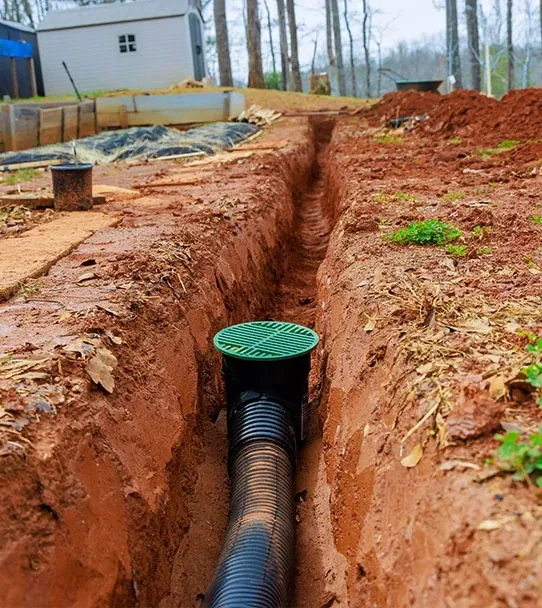
The property owner, from the building to the main. Glendale’s municipal code says all house connections, including the wye or saddle at the sewer main, are maintained at the expense of the property owner. Public Works says it more bluntly to residents: you own the waste pipe all the way up to the city’s main line under the middle of the street, including the connection at the main. The city’s 2025 sewer management plan adds that Glendale does not own any portion of a lateral, upper or lower, and does not perform maintenance on one.
What the city looks after is the main. The plan counts about 351 miles of sewer main and a single pump station, serving roughly 200,000 people and carrying some 13 million gallons of wastewater a day. City crews aim to clean the whole system on an 18-month cycle, go back more often to a list of trouble spots, and are partway through televising every mile of pipe, a project the city plans to finish in 2027. There is no treatment plant inside the city limits. The flow goes to the Los Angeles-Glendale Water Reclamation Plant, which Glendale owns jointly with Los Angeles and which lies just outside the city, and the treated water it does not reuse is released to the Los Angeles River.
It is an old system. Glendale’s sewer design manual, written in 2009 and still attached to the 2025 plan, describes most of the mains as vitrified clay pipe and says about half of the system was by then more than 75 years old. The same manual sets the smallest house connection at six inches across and its standard slope at 2 percent.
When a City Tree’s Roots Are in Your Lateral
Glendale answers this one directly. Roots from a city tree in a lateral, Public Works says, generally come from a separation or deterioration of an old line, and the line can be repaired without taking the tree out. Its instruction is to call Maintenance Services at (818) 548-3950, so that the city’s forestry staff can inspect both the tree and the lateral, and it stresses that city staff should be called while the pipe is exposed. A tree in the parkway, the strip between the sidewalk and the gutter, belongs to the city. Do not expect it to be removed: the city takes out its trees only when they are dead, dying or a danger to public safety. So if a repair uncovers roots from a parkway tree, make that call before the trench is filled in.
Two Permits for One Pipe
- On your property. Repairing or replacing the sewer between the building and the sidewalk takes a plumbing permit from Building & Safety, which the city lists as “Sewer on Property.” Glendale’s permit guidance says licensed plumbing, general building and general engineering contractors may apply for a single-family plumbing permit, and so may an owner-builder.
- From the sidewalk to the main. The same guidance says any work from the sidewalk to the street requires a separate permit from Public Works Engineering, whose number is (818) 548-3945. The municipal code allows no excavation in the public right-of-way without a written permit from the director of public works, and the application calls for a cash deposit and whatever bond and insurance the city requires. The city’s permit portal lists this one as a right-of-way excavation permit for sewer contractors, and a pre-construction meeting with the city inspector has to be set up before any work begins.
- At the main. Where the main has no fitting for the connection, the sewer manual has the permit holder’s contractor install a saddle, and only after the main has been exposed and a city construction inspector has seen it.
- Recently paved streets. Glendale does not issue excavation permits for a street that was reconstructed, repaved or resurfaced within the last three years, or slurry sealed within the last year, unless the public works director grants an exemption. An emergency is one of the listed grounds for an exemption.
- A deadline to start. An excavation permit expires if the work has not begun within 60 days of the date it was issued, unless the city extends it.
We clear laterals all the way to the city main, and we repair them along that whole length. From the sidewalk out to the main, Glendale requires that separate right-of-way excavation permit from Public Works Engineering, the one its portal lists for sewer contractors. When a repair goes past the sidewalk, that part of our work is done under that permit. We repair without a trench where the pipe allows, by lining or bursting it, and we dig only where it does not.
If a Sewer Backs Up in Glendale
- Turn the water off and watch. This is the city’s own test. If sewage keeps coming out of a bathtub drain, a shower, a sink or a toilet with all the water in the house turned off, the source may be the city’s main, and Public Works wants a call to Maintenance Services at (818) 548-3950 immediately. Between 11:00 p.m. and 6:30 a.m. that number offers an after-hours emergency line that reaches an on-call employee, and the city says you may also call the Police Department.
- If it stops, it is yours. When the sewage stops backing up once the water is off, the city says the source is likely in your private waste line and that the next call is to a plumber.
- Check the cleanout. The city describes a cleanout as the access point, generally outside the home, where a plumber can snake the sewer, and says standing water in it means the system needs a plumber’s attention. That is where we open a blocked main line. If the house has no cleanout we work through a toilet or the roof vent, and we can install one after the line is running.
- A sewer smell with nothing backed up. Glendale’s advice is to look in the bathtub, the sink and the shower, check the crawl space for dripping or pooled water, and make sure the cleanout caps are secure. If you still cannot find the source, the city asks for a call to the same Maintenance Services number.
- Buying in Glendale? The buyer takes on the entire lateral, the part under the street included, so have it looked at first. A buyer’s sewer camera inspection from us comes with the video and a written summary.
Glendale’s Water
Where Does Glendale’s Water Come From?
From Glendale Water & Power, the city’s own utility, which also runs the electric system. Its water service dates to 1914 and reaches nearly the whole city through more than 36,000 service connections; a small area at the northern end is supplied by a neighboring water district instead. In 2025, according to the utility’s water quality report, it delivered 7.5 billion gallons of drinking water. About 63 percent of the city’s supply was imported water bought from the Metropolitan Water District, which Glendale helped found in 1928 as one of 13 original member cities. About 31 percent was local groundwater, pumped from the basin beneath the San Fernando Valley and cleaned at the Glendale Water Treatment Plant. The remaining 5 percent was recycled water from the reclamation plant, used only for irrigation and industrial processes. Behind the tap are 384 miles of water main, 25 pumping stations, 25 reservoirs and tanks, and seven main pressure zones.
The municipal code divides the plumbing at the meter. The utility furnishes, installs and maintains the service connection, and the meter is its property, shutoff valves included. The code also says the city is not liable for damage caused by water beyond its meters, which in practice leaves the pipe from the meter to the building, and everything inside, to the owner. One detail surprises people. The shutoff at the meter is installed for the utility’s own use, and the code tells customers not to operate it except in an emergency and to provide their own valves on their own premises. If the shutoff at your house is seized or missing, we can fit a working emergency shutoff valve. A broken main or a leak on the street side belongs on the utility’s emergency line, (818) 548-2011.
How Hard Is Glendale’s Water?
That depends on which supply reaches your tap. The 2025 report lists hardness of 350 parts per million for the Glendale Water Treatment Plant, an average of 234 for one of the two plants that treat the imported water, and an average of 140 for the other. Hardness, the report explains, is mostly magnesium and calcium that occur naturally, and dividing parts per million by 17.1 converts the figure to grains per gallon. The utility tells customers that the white, chalky residue on glassware and faucets is harmless and shows most where water is heated or cooled. In a tank water heater the mineral collects as sediment. On home water treatment devices, its position is that they are a personal choice, are not needed for safety, and can cause problems of their own when they are poorly maintained.
Catching a Leak Before the Bill Does
Glendale Water & Power’s WaterInsight portal shows your water use in near real time, checks for potential leaks and can send a leak alert. For a toilet, the utility’s test is a few drops of food coloring in the tank: if the color seeps into the bowl without a flush, the toilet is leaking. There is a rule behind this as well. The city’s no water waste policy is in effect at all times, and it says no customer shall permit water to leak from any facility on the premises, with 72 hours to make the repair after the leak is discovered or the customer is notified. When the portal or the meter says water is moving and you cannot find where, our leak detection can. For a leak under a slab we can repair the one spot or reroute the line, and the reroute is what we usually recommend. A floor that has to be opened is closed with a rough concrete patch, and the finished flooring is left for you to restore.

Your Friendly Neighborhood Plumber
We proudly provide high-quality plumbing services to customers in:
- Acton
- Alhambra
- Arcadia
- Atwater Village
- Burbank
- California City
- City of Commerce
- Covina
- Downey
- East Los Angeles
- El Monte
- Fullerton
- Glendale
- Huntington Beach
- Inglewood
- La Habra
- Lake Hughes
- Lake Los Angeles
- Lancaster
- Leona Valley
- Littlerock
- Llano
- Long Beach
- Los Feliz
- Mojave
- Montebello
- Monterey Park
- Norwalk
- Palmdale
- Pasadena
- Pearblossom
- Pico Rivera
- Placentia
- Quartz Hill
- Rosamond
- San Gabriel
- San Pedro
- Santa Clarita
- Santa Monica
- South San Gabriel
- Sun Village
- Torrance
- Van Nuys
- San Fernando Valley
- South Bay
- West Covina
- Whittier
- Orange County
- Inland Empire
We’re known for customer-focused service, honest pricing, and professional results. No matter how far our service area grows, we remain committed to delivering personalized plumbing care to every customer we serve.
Additional Information
Glendale plumbing permits: who issues them, and who may apply?
Glendale’s Building & Safety Division issues them. Its public counter, in the Municipal Services Building at 633 East Broadway, is open from 7:00 a.m. to noon, but very little happens there: the city says all of its permits are submitted, reviewed and issued online through its Glendale Permits portal, and that nothing is submitted in person. The portal has separate plumbing permit types for a water heater, for a sewer on the property and for general plumbing work, and an issued permit is good for 180 days. Questions about whether a job needs a permit go to (818) 548-3200. The 2025 California Plumbing Code, with Glendale’s amendments, applies to projects submitted on or after January 1, 2026. Who may apply depends on the building. For a single-family house, the city’s guidance accepts a licensed plumbing, general building or general engineering contractor, or the owner as an owner-builder, so we can pull the permit for you, or you can pull it yourself if you prefer. For a multi-family building, Glendale does not accept owner-builder applications for plumbing permits, and for work inside a condominium it asks for a letter from the homeowners association.
Does Glendale restrict when plumbing work can be done?
Near homes, yes. Glendale’s noise ordinance makes it unlawful, in a residential zone or within 500 feet of one, to operate equipment or do outside construction or repair work between 7:00 p.m. and 7:00 a.m., from 7:00 p.m. on Saturday until 7:00 a.m. on Monday, or from 7:00 p.m. on the eve of a city holiday until 7:00 a.m. on the day after it, unless the building official has issued a permit for those hours. Emergency work needs no such permit. So a repipe, a water heater replacement or a lateral repair is a daytime job, Monday through Saturday, and a burst pipe or a sewer backup is dealt with when it happens.
Is every Glendale address on the city’s own sewer and water?
Nearly every one, with exceptions at the edges. On the water side, the utility’s report says a small area in the northern part of the city is served by a neighboring water district. On the sewer side, the city’s 2025 plan notes that a sewer trunk belonging to that same district runs through Glendale, and that some pipes in hillside sewer easements cross between Glendale and Los Angeles, so city crews sometimes have to work out whose pipe a problem is in. The municipal code likewise sets apart property that is served directly by a Los Angeles sewer line. If your address is one of these, the permit for the street side of a repair may come from a different agency, and that is worth settling before anyone digs. The hills add a practical point of their own. The Housing Element says slopes in Glendale’s mountainous areas often exceed a 60 percent grade, and a lateral on ground like that can be long and awkward to reach. On a hillside lot the first step is a camera through the line, so that any repair is planned around what the pipe actually looks like.
Do you work on apartment buildings in Glendale?
Yes. By the Housing Element’s count more than half of Glendale’s housing is in buildings of five or more units, and the city’s 2024 figures show about 65 percent of housing units occupied by renters. We work for owners and property managers on shared drain lines, building water heaters and emergency backups, with a free estimate and the price agreed before the work. Glendale does not take owner-builder applications for plumbing permits on multi-family buildings, so the application comes from the contractor. A line that backs up again and again can be put on a recurring cleaning.
Glendale Plumbing Help, Day or Night
Rooter & Plumbing Masters is a veteran-owned company, and Spanish is spoken in our office and on our crews. A drain that is slow again three weeks after it was snaked, roots in a lateral, a meter turning in an empty house, a water heater standing in a puddle: each one is a smaller job today than it will be after it floods a floor.
Call (888) 855-6680 at any hour for a free estimate in Glendale, CA. Same-day service is available.
Common Questions
Plumbers in Glendale, CA — Common Questions
Is there a plumber available in Glendale right now?
Yes. Rooter & Plumbing Masters runs open 24 hours a day, 7 days a week, including nights, weekends and holidays. Calls to (888) 855-6680 are answered by a person rather than an answering service, and crews are dispatched from our own shop at 1601 Paramount Blvd. in Montebello.
How much does a plumber cost in Glendale?
It depends on what is wrong, how accessible the pipe is and whether the fix is a repair or a replacement, so no honest plumber can quote a figure over the phone without knowing those. The estimate is free, and you get the price for the job before any work starts. Financing is available if the repair is a large one.
Are you licensed, bonded and insured?
Yes. Rooter & Plumbing Masters holds California CSLB contractor license #1004038 and carries insurance. You can verify the license yourself through the CSLB's public license lookup, and we would rather you did.
How quickly can you get to Glendale?
For emergency calls we usually arrive within the hour. For everything else we offer same-day availability and will not promise an arrival window before we know what else is running. Call (888) 855-6680 and the dispatcher will give you a real time rather than a guess. Glendale is inside our regular service area, so it is not an out-of-area trip.
What plumbing problems do you handle in Glendale?
Clogged and slow drains, sewer line backups and rooter work, hydro jetting, sewer camera inspections, leak detection, water heater repair and replacement, gas line repair and installation, repiping and pipe repair, toilets, sinks, showers and tubs, emergency shutoff valves, and commercial plumbing. Residential and commercial both.
¿Hablan español?
Sí. Se habla español — you can call (888) 855-6680 and speak Spanish with our office and with the crew that comes out. Parts of our site are published in Spanish as well.