Plumbing, Sewer & Rooter — Open 24/7
Plumber in South San Gabriel, CA
Clogged drains, sewer backups, water heaters and leaks, handled by licensed plumbers dispatched from our own shop in Montebello, one freeway exit away. Same-day availability, free estimates, and a person on the phone at 2am.
- 24/7 emergency service
- Free estimates
- Same-day availability
- Priced before work starts
- Financing available
- Se habla español
Josh and Oscar came on a short notice over the weekend to resolve an emergency at my dental office. Josh did a great job communicating professionally and Oscar even rushed over after church to get the job done on Sunday. The job itself was challenging, but it was resolved without any issues. I will be sure to call RPM next time.
Excellent & fast same day service. Showed up when they were scheduled so we were not sitting around waiting time. Great communication as well.
Request a free estimate in South San Gabriel
No charge for the estimate, and we price the job before any work starts. Prefer to talk? Call (888) 855-6680 — someone answers 24/7.
- Serving
- South San Gabriel, CA and the San Gabriel Valley
- Hours
- Open 24 hours a day, 7 days a week
- Dispatched from
- 1601 Paramount Blvd., Montebello, CA 90640
- License
- Licensed, bonded and insured — CSLB #1004038
- Estimates
- Free, with the price agreed before any work starts
- Languages
- English and Spanish
- Financing
- Available through Hearth for larger repairs and replacements
- Emergencies
- Nights, weekends and holidays on the same number
Local, Licensed & Available 24/7
About Our South San Gabriel Plumbers
Rooter & Plumbing Masters works in South San Gabriel from our own shop in Montebello, the city on its southern edge. Our licensed South San Gabriel plumbers open backed-up sewer lines, track down leaks nobody has seen yet, change out water heaters and repair gas piping, in the ranch houses on its cul-de-sacs and the few businesses along Hill Drive. The estimate is free, and nothing is started until you have agreed to the price.
South San Gabriel is not a city. It is an unincorporated community of Los Angeles County, close to one square mile in size with about 7,600 residents by the county’s count, and it is part of none of the surrounding cities. Rosemead borders it on the north and east, Montebello on the south and Monterey Park on the west, and San Gabriel, the city whose name it shares, lies farther north. That matters for plumbing more than it sounds. The permits, the sewer mains and the rules for digging in the street here all belong to the county, and none of those cities’ building departments or codes applies.
Los Angeles County’s historic context statement for the area tells how it grew. The land was farmed first. Advertisements from the early 1900s offered South San Gabriel property as large agricultural parcels, strawberry land in particular, or as tracts meant for later subdivision. Richard Garvey Sr. had bought land here in 1879 and started subdividing his ranch in 1892. By 1926, maps showed the main streets in place and a diagonal grid set along Hill Drive. In January 1952 three small communities voted to combine under the name South San Gabriel. In the early 1960s a local improvement association pushed for annexation by Rosemead, chiefly because Rosemead had no property tax. The effort was dropped after three attempts before that city’s council, and South San Gabriel is unincorporated to this day.
Nearly all of it is housing now. The county describes the stock as primarily post-war single-family tract housing, most of it in versions of the ranch style, with newer infill. The northwest corner was built first, mainly in the 1930s and 1940s, with a few lots from the late 1920s. Southwest of the power line easement that cuts across the community on a diagonal, almost everything dates from after World War II, and cul-de-sac tracts were added in the 1960s along the northeastern and southwestern edges. By the county’s figures 85 percent of the homes are single-family and 67 percent of the housing was built before 1979. In houses from the 1950s and 60s the drain lines are typically cast iron and clay, and that pipe is failing now. The prewar blocks have been on theirs even longer.
Plumbing Problems We See Most in South San Gabriel
A main line that backs up in a tract house. The clay and cast iron under these houses went in when they were built, and after that long in the ground, roots work in at the joints. It usually shows first at the lowest drain, a tub or a shower that fills when the washing machine empties. Our drain cleaning opens the line through the cleanout outside the house. Each time we clear a main line we follow it with a camera inspection at no charge, which shows what stopped it. Here the lateral is the owner’s to keep up for its whole length, and the county’s rule is explained lower on this page.
A clog that returns a few weeks after it was cleared. A crack, a joint that has slipped or a low spot that holds water will catch paper again no matter how well the line was cleaned. When the camera finds one bad stretch, the fix is drain repair. When the pipe has failed along its length, it is a drain replacement. Buying one of the older houses here? Have a sewer camera inspection done before escrow closes. Our inspection for buyers comes with the video and a written summary.
Grease in the kitchen line. A cable pushed through grease only pokes a hole in it, and the line closes up again. For a kitchen drain that keeps clogging, hydro jetting is what we usually recommend, because the water scours the pipe wall clean. The county’s sewer district asks households to help: scrape plates into the trash, and pour cooled grease into a container instead of down the sink. For a restaurant or a shop, our commercial plumbing crews do the same work on larger lines.
Water where it should not be. A ceiling stain, a warm or damp patch on a slab floor, a meter that keeps turning with every tap closed. We find a hidden leak with listening equipment and, if it is needed, tracer gas, and we do not open a wall or a floor until we know where the water is coming from. A leak under the slab can be repaired at the spot or bypassed by rerouting the pipe around the slab, and the reroute is what we usually advise. Where concrete has to be cut, we leave a rough concrete patch, and the finished flooring is yours to arrange.
Hard water and an aging water heater. Golden State Water Company’s report on its South San Gabriel system for 2025 lists hardness averaging 240 milligrams per liter, about 14 grains per gallon, in a range of 189 to 310. Water that hard leaves scale in a tank, and the sediment builds up at the bottom over the years. When the tank itself starts to leak, it is replaced, not repaired. The county’s own example of a permit that needs no plan check is the replacement of a residential water heater. Our water heater service covers gas and electric units.
A gas smell, a meter the utility has shut off, a new appliance. The county’s area plan names the Southern California Gas Company as the gas utility here. If you smell gas, get everyone out first and call SoCalGas at 1-800-427-2200 or 911 from outside. After the utility has made the property safe, gas line repair in South San Gabriel is our part: the leaking pipe or fitting is replaced and the system is pressure tested before the gas is turned back on. We run new lines for a range, a dryer, a water heater or a backyard grill or fire pit, where the trench is part of the job. Los Angeles County does not require an earthquake gas valve in its unincorporated areas, but if you want one we install the motion-type valves along with other emergency shutoff valves.
Get Our Services
Need a Plumber in South San Gabriel?
Call and say what is happening in plain words. A burst pipe or sewage on the floor is emergency plumbing, and that phone is answered day and night. A dripping faucet, a toilet that will not stop running or a hose bib that will not shut off is ordinary plumbing repair, set for a time that works for you. One bad length of water pipe is a pipe repair, and a house whose old pipe keeps springing leaks may be due for repiping. If your mail says Rosemead but your street is in South San Gabriel, we know where that is. Our South San Gabriel plumbers answer (888) 855-6680 at any hour. Se habla español.
Experienced Professionals
Plumbing Services for South San Gabriel Homes and Businesses
Most of our South San Gabriel calls come from houses: the cul-de-sacs off Potrero Grande Drive and Del Mar Avenue, the blocks on either side of Hill Drive, and the streets that run out to San Gabriel Boulevard and Paramount Boulevard. The trucks carry sewer cameras, hydro jetters and the electronic leak detection equipment we find leaks with. When a failed sewer line lies under a driveway, a patio or a planted front yard, ask whether it can be replaced without a trench. We have three ways of doing that: a cured-in-place liner set inside the old pipe, a new pipe burst through it, or an epoxy coating sprayed inside cast iron, and the camera tells us which one the old line can take. We also install and repair sinks and showers and bathtubs, and a drain that needs regular attention can go on scheduled plumbing maintenance. Homeowners, landlords and businesses get the same terms: the estimate is free, and the price is agreed before work starts.
Our Plumbing Services in South San Gabriel, CA:
South San Gabriel Sewer Laterals
South San Gabriel Sewer Line Responsibility: Homeowner or County?
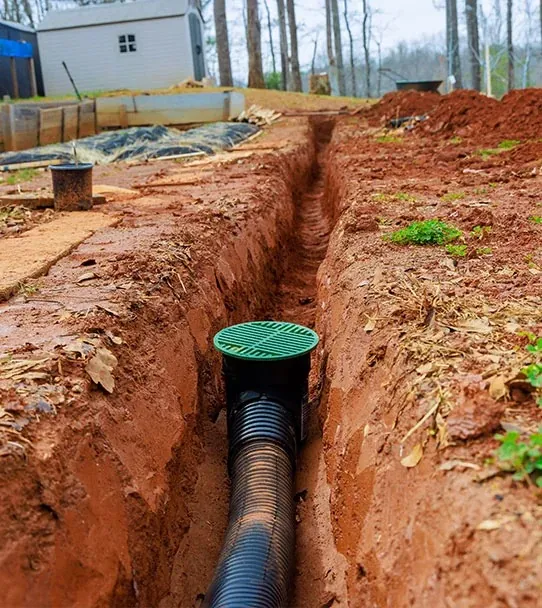
The homeowner, from the house to the main. There is no city sewer department here, because there is no city. The mains under South San Gabriel’s streets are kept up by the Consolidated Sewer Maintenance District, a part of Los Angeles County Public Works that looks after about 4,600 miles of sewer pipe serving more than two million people. The district says plainly where its part stops. The laterals, it says, are owned entirely by the private property owner they serve, and that owner is responsible for the full length, the portion in the public right-of-way under the asphalt and the street landscaping included. The county code makes it a duty: every house lateral is to be maintained by the owner of the property served, in a safe and sanitary condition.
What the district does is the main. Its services are routine cleaning of the mainlines, emergency repairs, and answering overflows and stoppages, and it runs cameras through roughly 500 miles of sewer a year to grade the condition of the pipe. The larger sewers that carry the flow on to the treatment plants are operated by a separate agency, the Los Angeles County Sanitation Districts. The maintenance district is paid for by an annual sewer charge on the property tax roll.
Who Is Responsible for a Sewer Blockage under the Street in South San Gabriel?
The property owner. We clear a backed-up main line through the cleanout outside the house. Where a house has none, we go in through a pulled toilet or the roof vent, and we can add a cleanout once the line is open. The complimentary camera inspection that follows shows whether the trouble is under the lawn, the sidewalk or the road. We clear laterals all the way to the main and repair them out to it as well. Past the property line, under a county road, the repair needs a Road Excavation Permit from Los Angeles County Public Works, and the county asks the applicant for the contractor’s license number and insurance, a site plan and an approved traffic control plan. We make repairs with no trench wherever the pipe allows, and if one means opening the county road, we do that part too, under the county’s Road Excavation Permit.
Sewer Work in the Road: the County’s Permit Rules
The permit. The county plumbing code forbids installing, removing, altering or repairing any part of a house sewer in a public way without a permit from Public Works. For a lateral that is a Road Excavation Permit, applied for online through the county’s EPIC-LA portal.
What the application asks for. The contractor’s license number and insurance, a site plan, traffic control plans approved by the county’s Traffic and Lighting Division, and a letter of authorization when the applicant is not the owner of the project. A new connection to the main also needs a tap and saddle receipt from Building and Safety, because the county’s own crews make the tap into its sewer.
How far the right-of-way reaches. Usually the whole width between the sidewalks on the two sides of the street, the sidewalks included, by the county’s description, and in some places several feet past the sidewalk.
An emergency does not wait for paperwork. The county highway code lets an excavation that is necessary to preserve life or property go ahead, so long as a permit is applied for by the next business day.
Putting the road back. Where pavement has been removed, the same code has the permit holder replace it one inch thicker than the pavement around it, and never less than two inches thick.
How long it takes. The county says most simple road permits can be processed within two weeks.
When a South San Gabriel Sewer Line Backs Up
Turn off what is running. Stop the washer, the dishwasher and the showers. Whatever goes down a blocked line comes back up at the lowest drain in the house.
Look at the street. Sewage coming out of a manhole means the main is blocked, and that is the county’s to clear. Los Angeles County Public Works takes urgent calls at any hour at (800) 675-4357. It says it will come out to clean or repair the public main, and it asks you to call even when you are not sure whose pipe it is.
Find the cleanout. Look for a capped pipe near the foundation or in the front yard. If there is none, tell us when you call, so the crew comes ready to work without one.
Ask whether the house needs a backwater valve. Most do not, the county says. The ones that do were built with the lowest fixture drain below the upper manhole of the public sewer. The valve closes on its own when the main backs up, and it has to be maintained to keep doing that.
If the county writes to you. The district’s camera work sometimes finds roots or debris pushing out of a private lateral toward the main. The owner then gets a courtesy notice that cites the lateral maintenance rule and lists what to do. Read us the notice when you call.
Do not put off a broken lateral. The county’s position is that a lateral problem must be repaired as soon as possible once the owner knows about it, because a lateral that leaks or overflows is a public health risk.
Water in South San Gabriel
Who Supplies Water in South San Gabriel?
Not the county, and not a city. Two water companies split the community, and which one is yours depends on the street. Los Angeles County Public Works’ service area map shows Golden State Water Company on roughly the northern and western blocks and San Gabriel Valley Water Company on the south and east. The name on your bill settles it.
Golden State Water calls its system here the South San Gabriel System. Its water is treated groundwater pumped from the basin that lies under the San Gabriel Valley, and the company can supplement it with imported water from the Colorado River Aqueduct and the State Water Project. Both companies have their rates set by the California Public Utilities Commission.
Main breaks, leaks at the service or the meter and pressure problems are the water company’s to answer. Golden State Water’s customer service center picks up 24 hours a day at 1-800-999-4033. San Gabriel Valley Water Company’s office is at (626) 448-6183, and its line for emergencies after hours and on weekends is (626) 448-4029.
Can I Turn Off the Water at the Meter in South San Gabriel?
San Gabriel Valley Water Company tells its customers not to. The angle stop and the meter valve are company property, it says, and the valve to use is the customer’s own gate valve. That valve is usually near the front of the house where the supply pipe comes in, often below the hose bib, or in the meter box on the side of the meter closest to the house. The company asks every household to find it before it is needed, and it offers customers who cannot find one a free turn-off for repairs during business hours. If yours is seized, buried or missing, we replace it with a working emergency shutoff valve. Golden State Water customers should ask their own company what it allows at the meter.
How Do I Check for a Leak at the Meter?
San Gabriel Valley Water Company’s method for a classic dial meter takes a quarter of an hour. Turn off every tap and appliance that uses water, note where the sweep hand sits, and look again after 10 to 15 minutes. If the hand has moved, water is going somewhere. Its automated-reading meters show a faucet icon on the display instead: no icon means no leak was detected in the past 24 hours, a flashing icon an intermittent one, and a solid icon a continuous one. When the meter says there is a leak and you cannot find it, that is the call to make to us.
Your Friendly Neighborhood Plumber
We proudly provide high-quality plumbing services to customers in:
- Acton
- Alhambra
- Arcadia
- Atwater Village
- Burbank
- California City
- City of Commerce
- Covina
- Downey
- East Los Angeles
- El Monte
- Fullerton
- Glendale
- Huntington Beach
- Inglewood
- La Habra
- Lake Hughes
- Lake Los Angeles
- Lancaster
- Leona Valley
- Littlerock
- Llano
- Los Feliz
- Long Beach
- Mojave
- Montebello
- Monterey Park
- Norwalk
- Palmdale
- Pasadena
- Pearblossom
- Pico Rivera
- Placentia
- Quartz Hill
- Rosamond
- San Gabriel
- San Pedro
- Santa Clarita
- Santa Monica
- South San Gabriel
- Sun Village
- Torrance
- Van Nuys
- San Fernando Valley
- South Bay
- West Covina
- Whittier
- Orange County
- Inland Empire
We’re known for customer-focused service, honest pricing, and professional results. No matter how far our service area grows, we remain committed to delivering personalized plumbing care to every customer we serve.
Additional Information
South San Gabriel plumbing permits: which office issues them?
Los Angeles County does, through the Building and Safety Division of Public Works. No city building department has a say here, whatever city your mail names. The county’s district map places South San Gabriel with its East Los Angeles office, at 4801 East 3rd Street, reachable at (323) 881-7030, and permits for unincorporated areas are applied for online through the county’s EPIC-LA portal. The county’s plumbing code is the 2025 California Plumbing Code with the county’s own amendments.
Does my plumbing job need a county permit?
Gas piping, plumbing, drainage and house sewer work all require one under the county plumbing code. The code exempts clearing a stoppage, and repairing a leak in a pipe, valve or fixture when nothing has to be replaced or rearranged. Working out whether your job needs a permit is part of our free estimate.
Can I pull the permit myself?
If you own a single-family house and live in it, yes. The county code allows a permit to the bona fide owner of a single-family dwelling that the owner occupies, for plumbing or drainage work in that house. Otherwise it reserves plumbing permits for licensed or registered contractors, with a few narrow exceptions. So on a house you own and live in, we can pull the permit for you, or you can pull it yourself if you prefer.
Are earthquake gas valves required in unincorporated Los Angeles County?
No. Building and Safety’s plan check guidance says a seismic gas shutoff valve is not mandatory in the unincorporated areas of the county, and adds that it has become commonplace to install them anyway, in new buildings and existing ones. A valve restricts the flow of gas, so the county has that loss counted when the gas piping is sized. Unincorporated is the word that matters: a city can set its own rule, and South San Gabriel follows the county’s.
Call Our South San Gabriel Plumbers
A tub that gurgles when the washing machine drains, a damp strip along the bottom of a wall, a water heater weeping at its base: each of these costs less to deal with this week than after it lets go. Tell us what you are seeing and we will tell you what it calls for.
Call us at (888) 855-6680 today to schedule your free estimate or same-day service in South San Gabriel, CA.
Common Questions
Plumbers in South San Gabriel, CA — Common Questions
Is there a plumber available in South San Gabriel right now?
Yes. Rooter & Plumbing Masters runs open 24 hours a day, 7 days a week, including nights, weekends and holidays. Calls to (888) 855-6680 are answered by a person rather than an answering service, and crews are dispatched from our own shop at 1601 Paramount Blvd. in Montebello.
How much does a plumber cost in South San Gabriel?
It depends on what is wrong, how accessible the pipe is and whether the fix is a repair or a replacement, so no honest plumber can quote a figure over the phone without knowing those. The estimate is free, and you get the price for the job before any work starts. Financing is available if the repair is a large one.
Are you licensed, bonded and insured?
Yes. Rooter & Plumbing Masters holds California CSLB contractor license #1004038 and carries insurance. You can verify the license yourself through the CSLB's public license lookup, and we would rather you did.
How quickly can you get to South San Gabriel?
For emergency calls we usually arrive within the hour. For everything else we offer same-day availability and will not promise an arrival window before we know what else is running. Call (888) 855-6680 and the dispatcher will give you a real time rather than a guess. South San Gabriel is inside our regular service area, so it is not an out-of-area trip.
What plumbing problems do you handle in South San Gabriel?
Clogged and slow drains, sewer line backups and rooter work, hydro jetting, sewer camera inspections, leak detection, water heater repair and replacement, gas line repair and installation, repiping and pipe repair, toilets, sinks, showers and tubs, emergency shutoff valves, and commercial plumbing. Residential and commercial both.
¿Hablan español?
Sí. Se habla español — you can call (888) 855-6680 and speak Spanish with our office and with the crew that comes out. Parts of our site are published in Spanish as well.